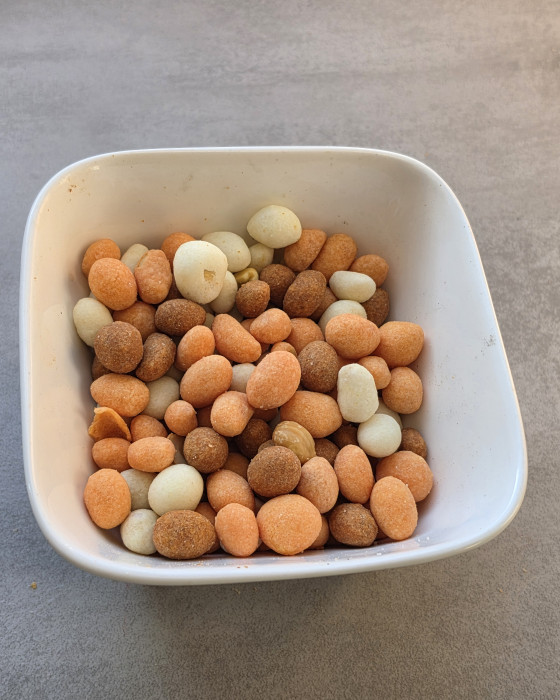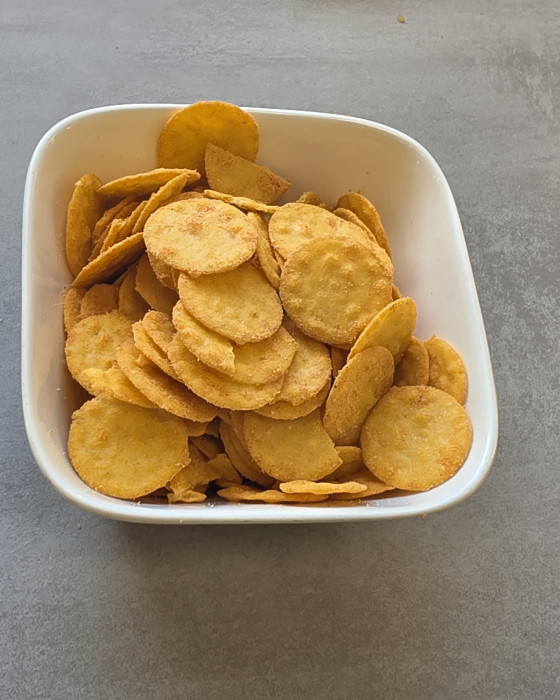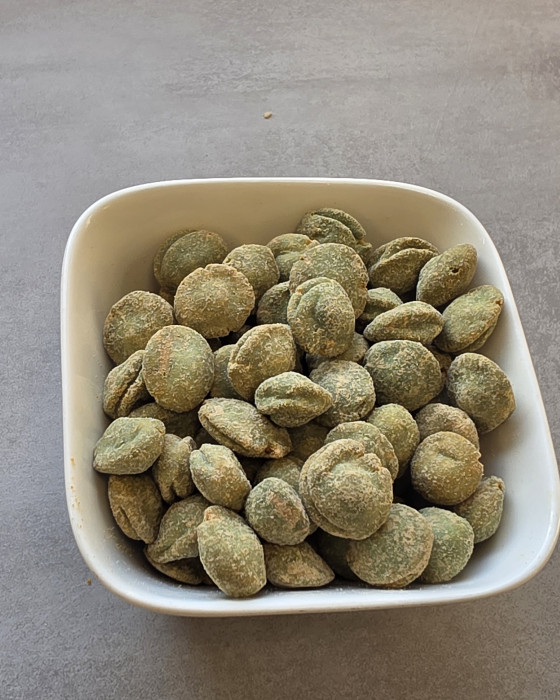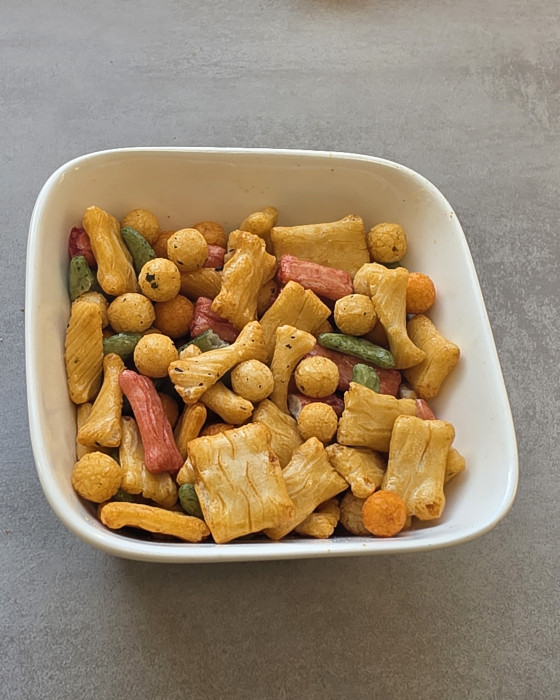
Rigato Mix
€ 2,25
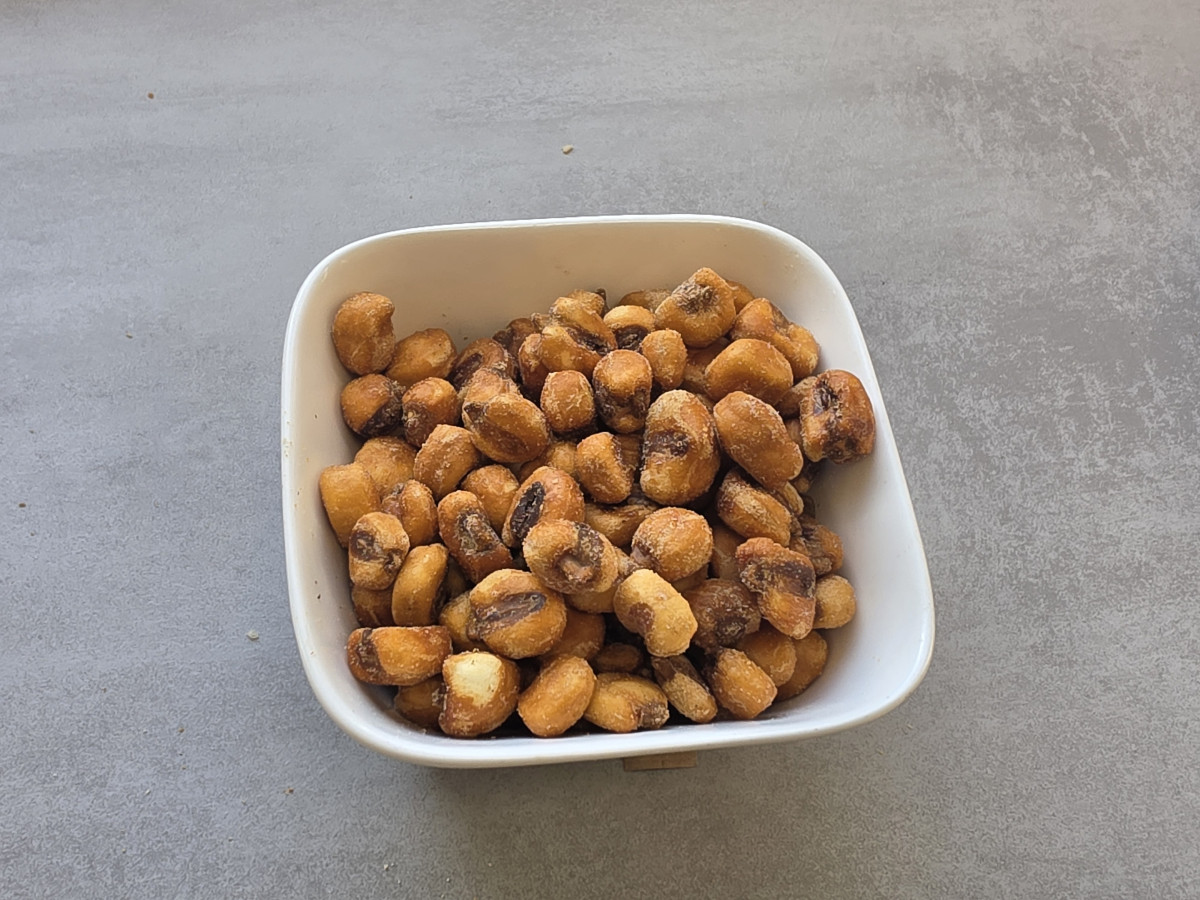
Also for sale at the stall: Tuesday in Goes, Thursday in Middelburg, Friday in Vlissingen and Saturday in Goes and Middelburg.
Rice Crackers & Snacks · 180 grams
A dent corn kernel (with a small dent in the kernel) consists of 80% carbohydrates (starch and sugars), 10% protein, 4.5% oil, 3.5% fibre and 2% minerals.
Free shipping from € 30 within the Netherlands, shipped with DHL.
Collect at the market stall your order is ready the day after you place it.
Belgium & Germany orders from € 50, free shipping from € 100; we ship Tuesday to Friday.
Pay with iDEAL | Wero or Bancontact


Product information
A dent corn kernel (with a small dent in the kernel) consists of 80% carbohydrates (starch and sugars), 10% protein, 4.5% oil, 3.5% fibre and 2% minerals. The starch consists mainly of two polysaccharides, of which amylopectin, at 75 to 80% of the polysaccharides, is the most important. Amylose is the other important polysaccharide. In waxy corn, the starch in the kernel consists mainly of amylopectin.
Corn is naturally gluten-free in the sense that it contains no gluten that causes coeliac disease.
Corn originally comes from Central America, where the indigenous inhabitants bred the crop into larger, more nutritious cobs. Time and again they picked the best, tastiest and largest cobs to propagate the corn. They probably started out with teosinte, a small grass plant. Columbus, who ‘discovered’ America in 1492, took the corn plant to Spain, where the crop thrived straight away. The Europeans then bred the corn further for the colder climate, after which the plant also did better and better in colder regions.
Corn or maize (Zea mays subsp. mays) is a cereal from Central America and belongs to the grass family. Corn is a direct domestication of teosinte, Zea mays ssp. parviglumis. In corn, the female and male flowers are separate, but on the same plant. The male flowers sit in the tassel at the top of the plant. About halfway up the plant, in the leaf axils, are one or more cobs made up of the female flowers.
Corn is pollinated by the wind. In the past, the varieties were so-called open-pollinated varieties. Today almost all corn varieties are hybrids. Corn belongs to the monocotyledons, or monocots. The food reserve of the corn kernel is therefore stored in the endosperm. A distinction is made between dent and flint corn. The dent kernel can be recognised by the small dent in the top of the kernel.
No reviews yet. Tasted it? Let us know what you think.
From the same stall
€ 2,25
€ 2,25
€ 2,25
€ 2,25